8 May 2026
Stop Reading Reviews One by One: The Monthly Report Habit Every Restaurant Needs
By Alper KOCA
It is a Tuesday morning. You open Google and there is a new 2-star review from Saturday night. You do not remember the table. You are not sure if it was a one-off or part of something bigger. So you write a response, close the tab, and hope it does not happen again.
That hope is not a strategy.
The problem is not that you got a bad review. Every restaurant does. The problem is that you are reading reviews one by one, in real time, with no way to tell the difference between a pattern and a bad evening.
A monthly review report fixes that.
What a monthly report actually does
It gives you distance. Instead of reacting to each review as it arrives, you look at everything together, once a month, and ask: what is actually happening here?
That shift — from reacting to reviewing — changes what you notice. A single complaint about slow service is easy to dismiss. Eight complaints about slow service on weekend evenings is a staffing problem.
The report does not create new information. It just makes the information you already have legible.
A real example
The Anchor is a pub-restaurant in a market town in Hampshire. In January their average Google rating was 4.3. By March it had quietly dropped to 4.1. They had not noticed because no single review seemed alarming.
When they looked at three months of reviews together, one theme stood out: "slow service" or "long wait" appeared in 14 reviews, almost all on Friday and Saturday evenings.
They added one extra member of staff on weekend evenings. By May, the rating was back at 4.4 and the theme had disappeared.
The fix was not complicated. But they could not have found it by reading reviews one at a time.
What to track each month
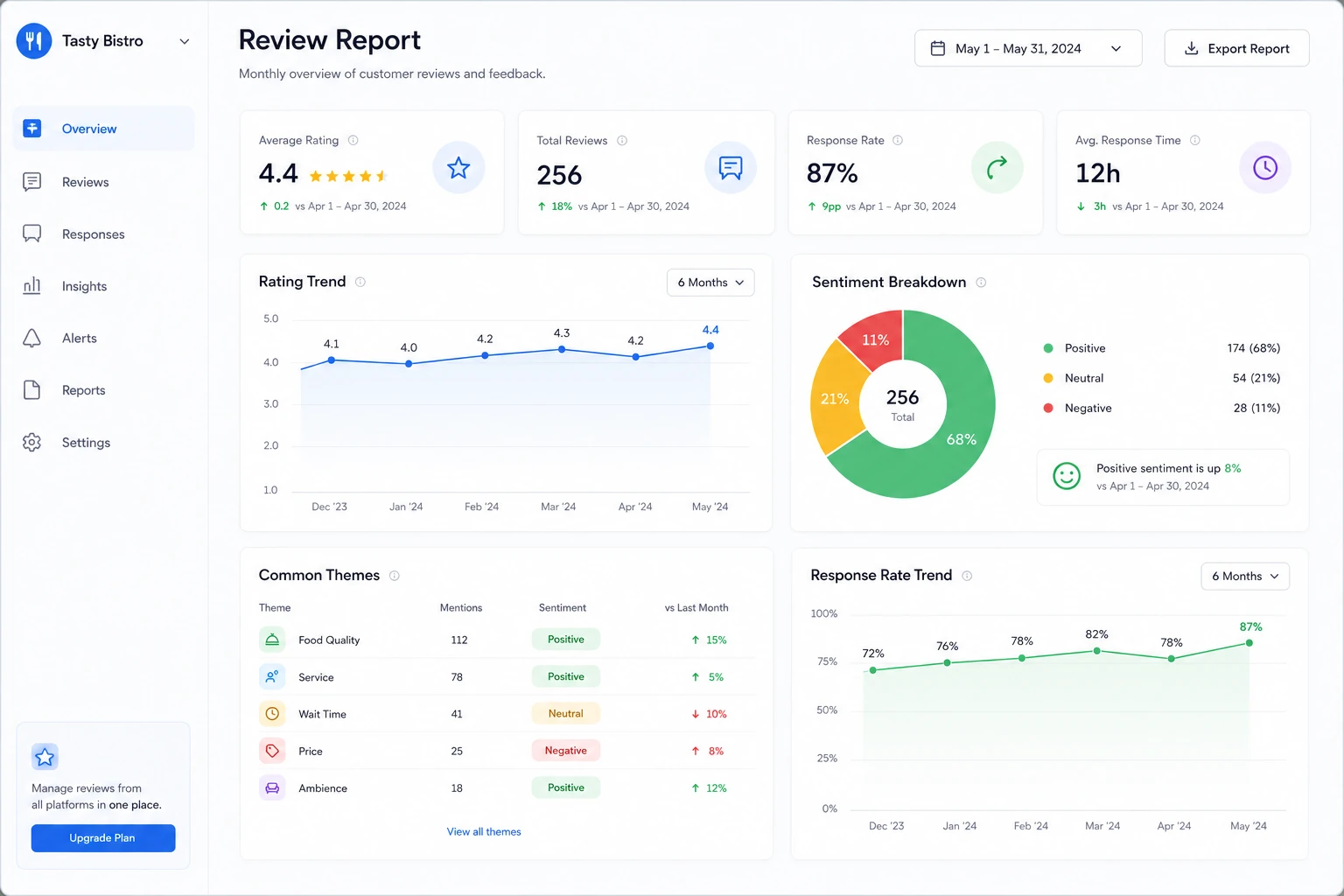
You do not need a complicated dashboard. Start with these five:
Average rating — your baseline. Watch the direction, not just the number. A 4.2 rising is healthier than a 4.6 falling.
Review volume — are customers still talking about you? A quiet month might mean fewer visits, or it might mean you have stopped asking. Either way, worth knowing.
Response rate — are you showing up in the conversation? Getting from 20 percent to 70 percent is a visible change. Customers notice. So does Google.
Sentiment themes — what words keep appearing? What topics come up more than once? This is where the real signal lives.
One trend to watch — not a list of every issue, just the one thing that changed this month compared to last. Did a new theme appear? Did an old one get worse or disappear?
How to read sentiment themes without spending hours on it
You are not looking for every opinion. You are looking for patterns.
Read through the month's reviews and ask: what comes up more than twice? It might be a specific dish, a specific day, a member of staff, the wait time, the noise level, the portion sizes. Anything that appears repeatedly is worth noting.
Then split it into two columns: what guests keep praising, and what guests keep criticising. That is your report.
If guests keep praising your Sunday roast, that is a marketing asset you are probably underusing. If guests keep mentioning a draught near the window, that is a £40 fix that might be costing you stars.
The one rule
Choose one action from the report each month. Not three, not a list. One.
The point of the report is not to give you more to worry about. It is to help you decide what to focus on. If service speed is the clearest issue, put your energy there. If a dish keeps coming up in glowing reviews, put it front and centre on your menu and your social.
Small, consistent improvements are how reputations are built.
Where Replicio fits in
Doing this manually takes time — reading through reviews, spotting themes, tracking how your rating has moved. For a busy restaurant, that hour rarely gets scheduled.
Replicio automates the pattern recognition. It reads your incoming reviews, surfaces the recurring themes, tracks your rating trend, and gives you a monthly summary you can act on in minutes rather than hours. You still make the decisions. You just do not have to do the data work first.
A habit worth building
A monthly review report is not a marketing tool. It is a management habit — the same kind of habit as checking your covers, your margins, your staff rota.
Reviews are already there, accumulating every week. The only question is whether you read them one at a time and react, or read them together and decide.
One hour a month. One action. That is enough to make a difference.